South China Sea Tensions: How Geopolitical Risk Threatens Semiconductor Investments & Supply Chains
By ClaritX Research Team ·
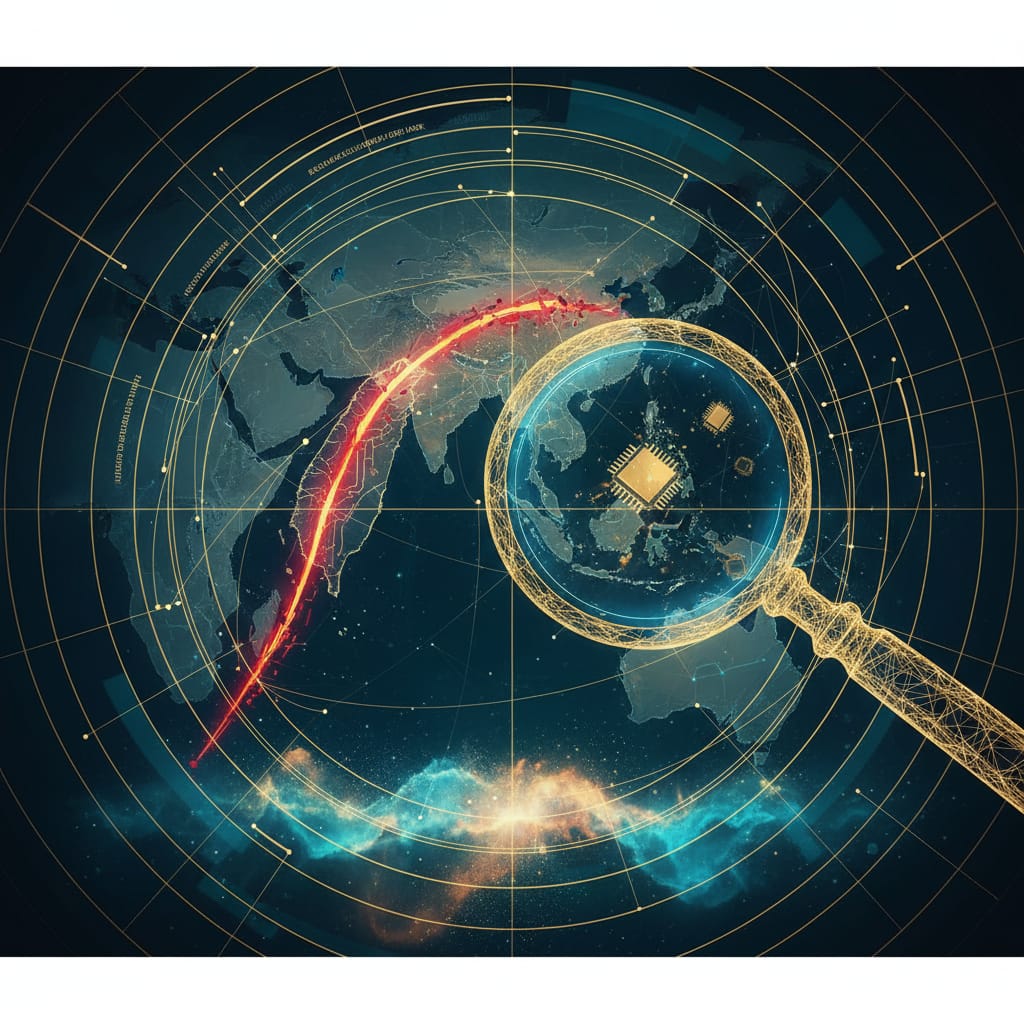
South China Sea Tensions: How Geopolitical Risk Threatens Semiconductor Investments & Supply Chains
February 7, 2026
The downing of a Philippine surveillance drone by a Chinese coast guard vessel in late January 2026 over the disputed Second Thomas Shoal did more than just create a diplomatic firestorm. For a few tense hours, it sent a shockwave through global markets, causing the Semiconductor Industry Index (SOX) to dip 4% before recovering. The incident, though seemingly minor, was a stark reminder of a question every serious investor must now confront: how vulnerable is my portfolio to a conflict in the South China Sea?
This isn't a theoretical exercise. The intricate dance of global commerce, particularly the highly concentrated semiconductor supply chain, passes through this increasingly militarized body of water. Understanding the nuances of this risk is no longer optional; it is fundamental to sound investment strategy in the current climate. A common mistake investors make is viewing geopolitical risk as a binary, "war or no war" scenario. In practice, the reality is a spectrum of "gray-zone" activities, each with cascading consequences for shipping costs, production lead times, and ultimately, corporate earnings.
This article will dissect the geopolitical landscape as of early 2026, quantify the South China Sea's critical role in global trade, model potential escalation scenarios, and outline a data-driven methodology for assessing and mitigating these profound risks.
Section 1: Understanding the Geopolitical Landscape (February 2026)
The situation in the South China Sea has grown more precarious over the past two years. As of February 2026, the region is characterized by a persistent state of low-intensity friction. A Crisis Group report from late 2025 highlighted a significant increase in "gray-zone" tactics by China, which involve the use of coast guard vessels, maritime militias, and cyber operations to assert territorial claims without triggering a conventional military response [3].
Recent events, documented by sources like Reuters and Bloomberg, paint a tense picture:
- Increased Naval Presence: The U.S. Navy has stepped up its Freedom of Navigation Operations (FONOPs), most recently in January 2026 near the Paracel Islands, drawing sharp condemnation from Beijing. In response, People's Liberation Army Navy (PLAN) warships now maintain a near-constant presence in contested areas. An analysis from the Institute for the Study of War notes that the frequency of these encounters has increased by over 30% since 2024 [6, 7].
- Philippine-China Flashpoints: The Philippines has become a central actor. Following the drone incident, Manila has deepened its military alliance with the United States, with joint naval exercises scheduled for March 2026. According to The Manila Times, the Philippine government is also pursuing international legal channels more aggressively than ever before [9].
- Rhetoric and Diplomacy: Public statements from all sides have become more resolute. A recent speech by China's foreign minister, reported by the South China Morning Post, reiterated "indisputable sovereignty" [8], while the U.S. Secretary of State has repeatedly affirmed that its mutual defense treaty with the Philippines extends to armed attacks on its coast guard in the South China Sea.
Historical patterns suggest that such a prolonged period of close-quarters military posturing, even if intended to be non-lethal, significantly raises the probability of an accidental collision or miscalculation that could escalate rapidly.
Section 2: The South China Sea's Critical Role in Global Trade and Semiconductors
To understand the investment risk, one must first grasp the sheer scale of the region's economic importance. The South China Sea is not just a body of water; it is the world's most critical commercial artery.
A Global Trade Superhighway
According to recent 2025 data from the United Nations Conference on Trade and Development (UNCTAD), approximately $5.3 trillion in annual trade passes through the South China Sea. This staggering figure represents nearly one-third of all global maritime trade [1, 2]. Key chokepoints like the Strait of Malacca, a narrow channel connecting the Indian Ocean to the South China Sea, see over 80,000 vessels transit each year.
For major economies, the reliance is acute:
- China: Nearly 60% of its trade passes through the region.
- Japan & South Korea: Over 40% of their maritime trade, including nearly all their energy imports from the Middle East, traverse these sea lanes [13].
- US & Europe: While the direct percentage is lower, the dependency is hidden within complex supply chains. A finished product assembled in Europe may rely on a dozen components that all made the journey through the South China Sea at some stage.
The Semiconductor Nerve Center
The global semiconductor industry is uniquely and terrifyingly exposed to the region. The supply chain can be visualized as a hyper-concentrated assembly line where a disruption at any single point brings the entire process to a halt.
- Fabrication and Manufacturing: A staggering 70-80% of global semiconductor manufacturing is located in and around the South China Sea, primarily in Taiwan (leading-edge logic chips), South Korea (memory chips), and China (mature-node chips and assembly). A 2025 report from the Atlas Institute for International Affairs notes that Taiwan alone accounts for over 60% of the global foundry market and over 90% of the most advanced sub-7nm chips [11].
- Assembly, Testing, and Packaging (ATP): A significant portion of the world's Outsourced Semiconductor Assembly and Test (OSAT) facilities are located in Taiwan, Malaysia, and China. Even chips fabricated in the U.S. or Europe are often shipped to Asia for packaging before being sent to their final destination.
- Raw Materials: The region is also a key transit route for crucial raw materials like silicon wafers and specialty chemicals required for chip production.
A blockage or even a significant slowdown in these shipping lanes would be like cutting the primary nerve of the digital economy. The impact would not be a gentle ripple; it would be a tsunami.
Section 3: Potential Escalation Scenarios and Their Impact
To move from abstract risk to actionable insight, sophisticated investors model specific scenarios. Based on analysis from think tanks like the Center for Strategic and International Studies (CSIS) [12] and various risk consulting firms, we can outline a tiered system of potential outcomes.
A common mistake is to only focus on the most dramatic, "black swan" event. However, the most probable and immediate risks are far more mundane, yet still incredibly damaging to investment portfolios.
| Scenario | Likelihood (Feb 2026) | Potential Impact on Semiconductor Supply Chain |
|---|---|---|
| 1. Intensified Gray-Zone | High | Description: Increased frequency of coast guard standoffs, use of water cannons, maritime militia "swarming," and cyber-attacks on port logistics. No shots fired.<br>Impact: Shipping insurance premiums for the region increase 50-100%. Vessels are forced to reroute around contested zones, adding 5-10 days to transit times. Estimated lead times for chips and components increase by 15-20%. |
| 2. Targeted Sanctions/Embargo | Medium | Description: Following a more serious incident (e.g., a ship collision causing casualties), the US and allies impose sanctions on specific Chinese entities. China retaliates with an "inspection quarantine" on all vessels heading to Taiwan.<br>Impact: Key Taiwanese foundries (like TSMC) face immediate delays in receiving raw materials and shipping finished wafers. Global electronics production is throttled. Estimated immediate production impact: 25-40% reduction in global leading-edge chip output. |
| 3. Open Conflict/Blockade | Low (but High-Impact) | Description: An armed exchange between naval vessels escalates. China declares an Air Defense Identification Zone (ADIZ) and a full maritime blockade of key shipping lanes or of Taiwan itself.<br>Impact: Catastrophic. The Strait of Malacca and Taiwan Strait effectively close. Global trade is thrown into chaos. Semiconductor production in the region halts completely. The ripple effect would trigger a global recession deeper than the 2008 financial crisis. |
Section 4: Assessing and Mitigating Risk with a Multi-Angle Methodology
Given the stakes, a "buy and hold" strategy without accounting for this new layer of geopolitical risk is insufficient. A modern, robust investment process requires a multi-angle approach to identify both vulnerabilities and resilient opportunities.
1. Multi-Angle Company Analysis
Evaluating a company, especially in the semiconductor sector, on financial metrics alone is now dangerously one-dimensional. A more resilient methodology involves integrating four distinct lenses:
- Fundamentals: Traditional analysis of balance sheets, cash flow, and P/E ratios.
- Geopolitical Exposure: Mapping a company's physical assets, key suppliers (Tier 1, 2, and 3), and customer base against the high-risk zones identified above. How much of their revenue or production is tied to facilities in Taiwan, China, or Malaysia?
- News & Sentiment Analysis: Using AI-powered tools to analyze real-time news flow, government publications, and social media to gauge shifting sentiment and early warnings of escalations. A sudden spike in negative sentiment around a company's primary manufacturing hub can be a powerful leading indicator.
- Technical & Quantitative Factors: Assessing market behavior, volatility, and capital flows to see how other institutional investors are pricing in these risks.
By combining these angles, an investor can build a much richer, more accurate picture of a company's true risk profile.
2. AI-Powered Resilience Rankings
Manually assessing the complex supply chains of hundreds of companies is impractical. This is where quantitative screening becomes essential. By building an AI model that ranks semiconductor companies based on resilience factors, investors can filter the universe of stocks into a manageable research list. Key inputs for such a ranking system would include:
- Geographical Diversification: Companies with fabs in multiple, politically stable regions (e.g., US, Europe, Japan) would rank higher than those concentrated solely in Taiwan or China.
- Supply Chain Redundancy: Does the company have multiple, pre-qualified suppliers for its critical raw materials and equipment? Evidence of this in annual reports or investor calls is a strong positive signal.
- Inventory Management: Companies holding larger buffers of critical inventory may be better positioned to weather short-term disruptions.
3. Portfolio Stress-Testing and Simulation
Finally, understanding your personal risk tolerance is essential before constructing any portfolio. The most effective way to do this is to move beyond theory and into simulation. A sophisticated portfolio simulator can allow an investor to model the impact of the scenarios outlined in Section 3 on their specific holdings.
For example, you could simulate the "Targeted Sanctions/Embargo" scenario. The model would apply the estimated 25-40% production cut to your holdings with high Taiwan exposure, recalculate their projected earnings, and show you the potential impact on your portfolio's total value. This kind of stress-testing transforms abstract geopolitical fears into concrete, quantifiable financial risk, allowing for more rational and informed asset allocation decisions.
Section 5: Examples of Companies at Risk (and Opportunities)
Let's apply this methodology to hypothetical, but realistic, examples in the current market.
High-Exposure Example: "Advanced Logic Inc." (ALI)
- Profile: A leading fabless designer of cutting-edge GPUs and AI accelerators.
- Vulnerability: ALI relies exclusively on a single foundry in Taiwan for the fabrication of its most advanced 3nm chips. Its financial reports indicate that over 85% of its revenue is derived from products manufactured at this facility. Furthermore, its primary assembly and testing partner is located in Kaohsiung, a major Taiwanese port city.
- Analysis: In Scenarios 1 or 2, ALI would face immediate and severe disruption. Increased shipping costs would erode its margins, and any quarantine or blockade of Taiwan would halt its production entirely. A multi-angle analysis would flag the extreme concentration of its manufacturing as a critical red flag, regardless of how strong its current earnings are.
More Resilient Example: "Global Materials & Equipment" (GME)
- Profile: A manufacturer of specialized manufacturing equipment and high-purity chemicals used in the semiconductor fabrication process.
- Resilience: Over the past three years, GME has aggressively diversified its footprint. While it still has significant operations in Asia, it has invested heavily in new plants in Arizona, USA, and Dresden, Germany, a fact highlighted in its 2025 annual report. The report also details a "multi-supplier" strategy for its own raw material inputs.
- Analysis: In a disruption scenario, GME would still be impacted, but its diversified global presence provides a crucial buffer. A blockade of the South China Sea might disrupt one part of its business, but its US and European operations could potentially ramp up production to serve Western clients. This geographical diversification makes it a potentially more resilient investment and could even present a long-term opportunity as the industry actively de-risks its supply chains. Investors using a resilience ranking system would likely see GME score highly.
Conclusion: Navigating the New Reality
The geopolitical tensions in the South China Sea are not a passing storm; they represent a fundamental, long-term shift in the global landscape. For investors in the semiconductor industry and beyond, ignoring this reality is an act of financial negligence. The potential for disruption—from minor delays to a full-blown crisis—is real, and the impact on the hyper-concentrated semiconductor supply chain could be immense.
However, risk and opportunity are two sides of the same coin. While the threats are daunting, they do not mean investors should abandon the semiconductor sector. Instead, a more sophisticated, data-driven approach is required. By employing a multi-angle analytical framework, utilizing quantitative tools to rank companies by their operational resilience, and stress-testing portfolios against credible scenarios, investors can navigate this volatile new world. The winners in the coming decade will be those who not only understand their investments but also understand the world in which they operate.
Key Takeaways:
- The South China Sea is a critical chokepoint for global trade, with over $5 trillion in commerce and the majority of the world's semiconductor supply chain transiting the region.
- Geopolitical risk is not a binary event but a spectrum of possibilities, with "gray-zone" tactics posing the most immediate and probable threat to supply chain stability.
- A one-dimensional investment analysis based solely on financials is no longer sufficient. A multi-angle approach that integrates geopolitical exposure, news sentiment, and supply chain mapping is essential.
- Investors should focus on identifying operationally resilient companies that have demonstrated a commitment to geographical diversification and supply chain redundancy.
- Portfolio simulation and stress-testing are critical tools for quantifying your personal exposure to these events and making informed asset allocation decisions.
---
Further Reading
--- This content is for educational purposes only and does not constitute investment advice. Past performance does not guarantee future results. All investments carry risk of principal loss. Always conduct your own research and consider consulting a qualified financial advisor before making investment decisions.
Sources
How this content was created
This article was created by the ClaritX Research Engine — an AI system that analyzes and cross-checks information from reliable, named sources (listed above). Published . Found an error? Report it — see our editorial policy and corrections process. Educational content only — not investment advice (full disclaimer).