The Current Situation at PayPal: Are All the Lawsuits Just Smoke?
By ClaritX Research Team ·
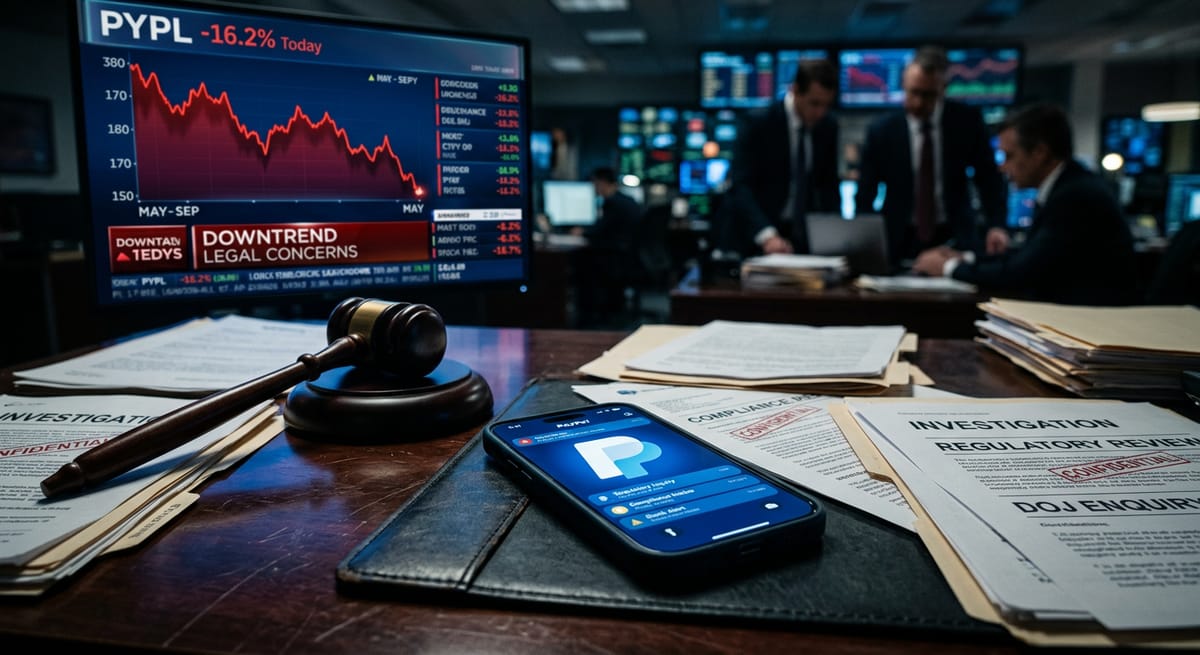
The digital payments landscape is undergoing a brutal recalibration, and perhaps no company exemplifies this better than PayPal Holdings, Inc. (NASDAQ: PYPL). As we move deeper into 2026, the pioneer of online checkout finds itself navigating a perfect storm: a disappointing Q4 2025 earnings report, an abrupt change in leadership, and a flurry of class-action lawsuits.
For investors watching the stock hover in the mid-$40s—a steep fall from its previous heights—the headlines are undoubtedly alarming. The financial news cycle has been dominated by legal notices urging shareholders to join class-action suits before the April 20, 2026 deadline. But for a company that generated over $5.5 billion in free cash flow last year, a critical question remains: are these lawsuits an existential threat to the business, or are they simply the standard legal "smoke" that follows any major stock drop?
In this comprehensive analysis, we will unpack the current situation at PayPal, dissect the claims in the ongoing securities lawsuits, review the company's recent regulatory victories against the CFPB, and evaluate whether the underlying fundamentals present a value trap or a hidden opportunity.
The Q4 2025 Earnings Shock and Leadership Shakeup
To understand the legal battles, we first have to look at the catalyst. On February 3, 2026, PayPal released its fourth-quarter and full-year 2025 financial results, and the market reaction was swift and unforgiving.
The Numbers That Spooked Wall Street
PayPal missed Wall Street's consensus estimates on both the top and bottom lines. The company reported non-GAAP earnings per share (EPS) of $1.23, missing the $1.29 estimate, while revenue came in at $8.68 billion against expectations of $8.80 billion. While Total Payment Volume (TPV) did rise 6% on a currency-neutral basis to $475.1 billion, the underlying metrics revealed weakness where it hurt the most: Branded Checkout.
Branded Checkout—the recognizable "Pay with PayPal" or "Venmo" buttons—is the company's highest-margin product. Online Branded Checkout volume grew by a meager 1%, a sharp deceleration from prior quarters. For a company fighting off aggressive incursions from Apple Pay and Google Pay, this stagnation signaled that PayPal was losing market share in its most profitable arena.
The Sudden Departure of Alex Chriss
Adding fuel to the fire, PayPal announced the abrupt departure of CEO Alex Chriss, who had been leading the company for roughly two and a half years. The Board of Directors cited that "the pace of change and execution was not in line with the Board's expectations". The company subsequently tapped Enrique Lores as the incoming executive to steer the ship.
Furthermore, management withdrew its previously optimistic 2027 financial targets. They issued muted 2026 guidance, projecting that full-year non-GAAP EPS would range from a low-single-digit decline to slightly positive growth compared to 2025's $5.31. The combination of missed earnings, a sudden CEO transition, and withdrawn guidance caused the stock to plummet over 20% in a single day, dropping from $52.33 to $41.70.
The Wave of Securities Class-Action Lawsuits
Whenever a publicly traded company experiences a sudden and severe drop in its stock price following a negative disclosure, it inevitably triggers a phenomenon known on Wall Street as the "stock drop lawsuit."
Following the February 3rd plunge, several prominent investor rights law firms—including Pomerantz LLP, The Rosen Law Firm, Robbins Geller Rudman & Dowd, and Kessler Topaz Meltzer & Check—filed class-action lawsuits on behalf of shareholders.
What Are the Shareholders Claiming?
The core of the lawsuits revolves around violations of the Securities Exchange Act of 1934. The plaintiffs allege that between February 2024 (or early 2025, depending on the specific filing) and February 2, 2026, PayPal's leadership made materially false and misleading statements regarding the company's growth strategy.
Specifically, the complaints focus on the following allegations:
- Overhyped Branded Checkout: Executives allegedly assured investors that they were successfully executing a transformation strategy to accelerate Branded Checkout growth and drive high single-digit transaction margin growth by 2027.
- Concealment of Operational Issues: The lawsuits claim that leadership knew, or should have known, that the company's salesforce was not equipped to execute these growth initiatives and that they were "too optimistic" about customer adoption.
- Unachievable 2027 Targets: Plaintiffs argue that the 2027 targets touted by former CEO Alex Chriss were fundamentally unachievable, requiring an unrealistically stable consumer landscape that ignored the mounting pressures from Big Tech competitors.
The Lead Plaintiff Deadline
These lawsuits have established a lead plaintiff deadline of April 20, 2026. During this period, law firms are actively soliciting investors who suffered substantial losses to step forward to represent the class.
Are These Lawsuits Just Smoke?
For retail investors, reading about "securities fraud" can be terrifying. However, it is crucial to separate the legal posturing from the fundamental realities of the business.
In the modern stock market, almost every single company that suffers a rapid 15% to 20% decline due to an earnings miss will face a class-action lawsuit. These suits are highly formulaic. The legal argument almost always boils down to: "The company said things were going well, but then things went poorly, therefore they must have been lying."
While these lawsuits represent a headache for PayPal's legal team and a distraction for the new CEO, they are rarely fatal. Most of these cases are either dismissed by a judge for failing to prove "scienter" (the actual intent to deceive) or are settled out of court for a fraction of the claimed damages, fully covered by the company's Directors and Officers (D&O) liability insurance.
Therefore, the class-action lawsuits are mostly "smoke." They are a symptom of the underlying problem—slowing growth and poor execution—rather than a distinct new threat to the company's survival.
The Regulatory Landscape: A Major Win Against the CFPB
While the shareholder lawsuits dominate the ticker feeds, PayPal recently achieved a massive and highly consequential legal victory on the regulatory front.
For years, PayPal has been locked in a legal battle with the Consumer Financial Protection Bureau (CFPB) over a 2019 rule governing prepaid cards and digital wallets. The CFPB had attempted to force digital wallet providers (like PayPal and Venmo) to disclose fees on a standardized physical form originally designed for traditional prepaid debit cards.
PayPal challenged the rule, arguing that digital wallets operate differently than prepaid cash cards because consumers primarily use them to store payment credentials rather than holding cash balances. The company argued that forcing them to provide disclosures for fees they did not even charge was confusing to consumers and represented regulatory overreach.
The End of the Appeal
After years of lower-court victories for PayPal, the CFPB formally threw in the towel in April 2025. Following a change in CFPB leadership, the agency agreed to drop its appeal in the D.C. Circuit Court of Appeals.
This is a massive fundamental victory for PayPal. It protects the operational agility of its Venmo and core PayPal digital wallet products, shielding them from heavy-handed, irrelevant regulatory disclosures that could have increased compliance costs and introduced friction to the user onboarding experience.
The Fundamentals: Value Trap or Coiled Spring?
If we clear away the smoke of the shareholder lawsuits, we are left with the core financial realities of PayPal in 2026. The stock is currently trading at roughly 8x trailing earnings—an incredibly depressed multiple for a tech-adjacent fintech pioneer.
The Bear Case
The bears argue that PayPal is a classic "value trap." The legacy payments space is becoming highly commoditized. Big Tech has successfully integrated payments at the hardware and operating system levels. When a consumer uses an iPhone, Apple Pay is the default, frictionless option. PayPal's management admitted that macroeconomic factors, combined with intense competition, caused their "operational and deployment issues". If Branded Checkout continues to stagnate, PayPal will be forced to rely on its unbranded processing business (Braintree), which yields significantly lower margins.
The Bull Case
The bulls see a company that is being priced for bankruptcy while generating massive cash flows. Despite the growth slowdown, PayPal remains highly profitable. In 2025, the company generated over $5.5 billion in free cash flow and aggressively returned capital to shareholders, executing roughly $6.0 billion in buybacks.
With 439 million active accounts and nearly half a trillion dollars in quarterly payment volume, PayPal has an unmatched global scale. The bullish thesis relies on the new CEO, Enrique Lores, setting a highly conservative baseline for 2026, allowing the company to easily hurdle lowered expectations in the coming quarters. Furthermore, new AI-driven integrations with platforms like Canva and expanded checkout capabilities could act as subtle catalysts for merchant volume.
Conclusion: Navigating the Noise
So, are the lawsuits at PayPal just smoke? Largely, yes. The securities class-action suits are a predictable byproduct of a disappointing earnings report and a painful stock correction. While they generate negative headlines, they do not impact the intrinsic cash-generating power of the business.
However, the smoke does point to a real fire: PayPal's struggle to maintain its moat in Branded Checkout against the relentless advance of Apple and Google. The true test for PayPal in 2026 is not whether its lawyers can settle a stock drop lawsuit, but whether its new leadership can revitalize product execution and prove that the pioneer of digital payments still has a place in the future of e-commerce.
For investors, PayPal presents a fascinating psychological test. It requires weighing a deeply discounted valuation and massive free cash flow against the very real threat of market share erosion. As always, cutting through the legal noise and focusing on the balance sheet is the best way to determine if a stock aligns with your portfolio strategy.
Related ClaritX Tools
Disclaimer: The information provided in this article is for educational purposes only and should not be construed as financial or investment advice. Always conduct your own research or consult with a certified financial professional before making investment decisions.
Sources
How this content was created
This article was created by the ClaritX Research Engine — an AI system that analyzes and cross-checks information from reliable, named sources (listed above). Published . Found an error? Report it — see our editorial policy and corrections process. Educational content only — not investment advice (full disclaimer).