How to Invest $1,000: Smart Strategies for Beginners in 2026
By Emily Rodriguez ·
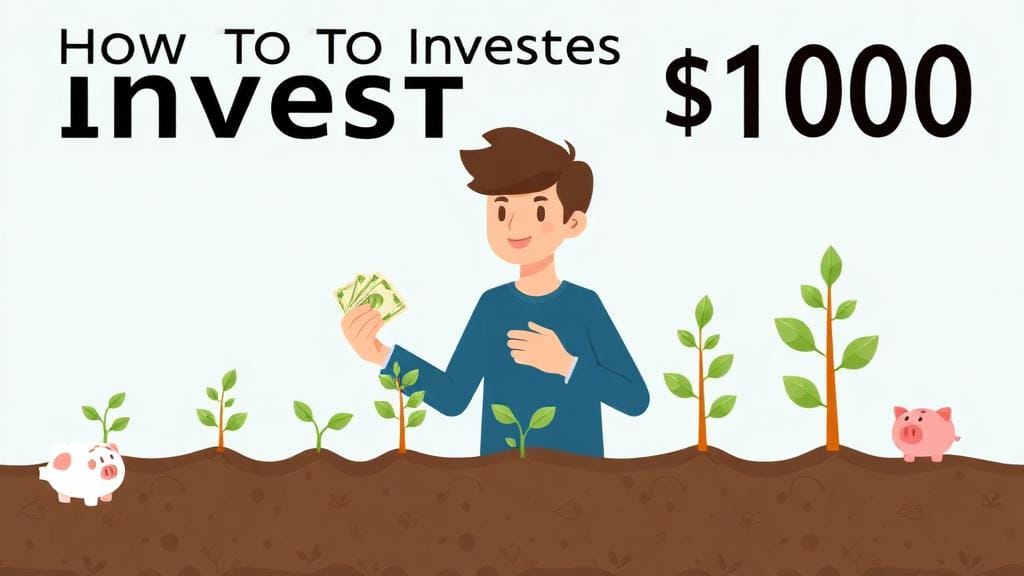
How to Invest $1,000: A Beginner's Guide to Growing Your Money
You've saved $1,000 and you're ready to invest. Congratulations—this decision puts you ahead of most people. But with endless options, where should you actually put your money? This guide breaks down the best strategies for investing $1,000 in 2026.
Why $1,000 Is the Perfect Starting Point
$1,000 is enough to:
- Open most brokerage accounts
- Build a diversified starter portfolio
- Learn investing mechanics with real money
- Develop habits that scale with larger amounts
What matters more than amount:
- Starting early (time in market)
- Learning the process
- Building investing discipline
- Making mistakes with amounts you can afford
Before You Invest: The Prerequisites
✅ Emergency Fund First
Don't invest your only $1,000. Before investing:
- Have 3-6 months expenses saved separately
- Keep emergency funds in high-yield savings (not stocks)
- Investing money you might need soon = risky
✅ Pay Off High-Interest Debt
Credit card debt at 20%+ interest? Pay that first. No investment reliably returns 20%+ annually.
✅ Understand Your Timeline
- Need money in 1-2 years? Savings account, not stocks
- 5+ year timeline? Stocks become appropriate
- 10+ years? Maximum growth potential
The Best Ways to Invest $1,000 in 2026
Option 1: Index Funds (Best for Most Beginners)
What they are: Funds that track market indexes like the S&P 500
Why they work:
- Instant diversification (500+ stocks in one purchase)
- Ultra-low fees (often 0.03% annually)
- No stock-picking required
- Historically ~10% average annual returns
How to start:
- Open brokerage account (Fidelity, Schwab, Vanguard)
- Buy S&P 500 index fund (VOO, SPY, or FXAIX)
- Set up automatic monthly investments
- Don't touch it for years
$1,000 example: Invest $1,000 in VOO at ~$500/share = 2 shares with automatic reinvestment.
Option 2: Target-Date Retirement Fund
What they are: All-in-one funds that adjust automatically as you age
Why they work:
- Pick your retirement year (e.g., 2060 fund)
- Fund automatically shifts from stocks to bonds over time
- Truly "set and forget"
- Perfect for retirement accounts
Best for: 401(k) and IRA investing with minimal effort
Option 3: Dividend ETFs
What they are: Funds holding dividend-paying stocks
Why they work:
- Regular income payments
- Tend to be more stable than growth stocks
- Reinvesting dividends accelerates compounding
Popular options:
- SCHD (Schwab US Dividend Equity)
- VYM (Vanguard High Dividend Yield)
- DGRO (iShares Core Dividend Growth)
Option 4: Individual Stocks (More Advanced)
When it makes sense:
- You're willing to research companies
- You understand you could lose money
- You won't panic-sell during drops
- You're diversifying across 10+ stocks
With $1,000, consider:
- Fractional shares (own part of expensive stocks)
- Well-known companies you understand
- Mix of sectors for diversification
Warning: Individual stock picking requires more time and carries more risk than index funds.
Option 5: Robo-Advisors
What they are: Automated investment services
Why they work:
- Answer questions, get a portfolio
- Automatic rebalancing
- Low minimums (some start at $1)
- Fees typically 0.25% annually
Popular options: Betterment, Wealthfront, M1 Finance
Where to Open Your Account
For Taxable Investing (Brokerage Account)
Best brokerages for beginners:
- Fidelity: No minimums, excellent research, fractional shares
- Charles Schwab: Full-service, great customer support
- Vanguard: Pioneer of low-cost investing
- Robinhood: Simple interface (limited features)
For Retirement (IRA)
Roth IRA benefits:
- Tax-free growth forever
- Tax-free withdrawals in retirement
- Can withdraw contributions anytime
- Best option if you expect higher taxes later
Traditional IRA benefits:
- Tax deduction now
- Taxes paid in retirement
- Best if you expect lower taxes later
Sample $1,000 Portfolios
Conservative Beginner Portfolio
- 100% Total Stock Market Index Fund (VTI or FSKAX)
- Add bond exposure as you approach goals
Balanced Beginner Portfolio
- 70% S&P 500 ETF (VOO)
- 20% International ETF (VXUS)
- 10% Bond ETF (BND)
Growth-Focused Portfolio
- 60% S&P 500 ETF
- 25% Growth ETF (VUG or QQQ)
- 15% Small Cap ETF (VB)
The Power of $1,000 Over Time
Assuming 8% average annual returns:
| Years | $1,000 Once | $1,000/Year |
|---|---|---|
| 10 | $2,159 | $15,645 |
| 20 | $4,661 | $49,423 |
| 30 | $10,063 | $122,346 |
| 40 | $21,725 | $279,781 |
This shows why starting matters more than the initial amount.
Common Beginner Mistakes to Avoid
❌ Waiting for the "Right Time"
There's no perfect time. Markets rise over time. Waiting costs you money.
❌ Checking Daily
Stock prices fluctuate. Checking constantly causes stress and bad decisions. Check monthly at most.
❌ Selling During Drops
Markets drop 10-20% regularly. Selling locks in losses. Stay invested through volatility.
❌ Picking "Hot" Stocks
Chasing trending stocks usually ends badly. Boring index funds outperform most stock pickers.
❌ Not Investing Enough
$1,000 once is good. $100/month consistently is better. Automate contributions.
After Your First $1,000
Next steps:
- Set up automatic monthly contributions ($50-$500+)
- Increase contributions when income rises
- Max out tax-advantaged accounts (IRA, 401k match)
- Reinvest all dividends
- Review annually, don't tinker monthly
The Most Important Lesson
Investing $1,000 matters less than:
- Starting the habit
- Continuing to add money
- Not panic-selling
- Being patient for decades
Your first $1,000 probably won't make you rich. But the habits you build with it will.
Related Reading
→ Stock Market Basics for Beginners - Understand how markets work
→ ETFs vs Individual Stocks - Which is right for you?
→ Dollar Cost Averaging Explained - Best strategy for regular investing
Start Your Investment Journey
→ Explore AI Stock Analysis - Research stocks with multi-angle analysis
→ Build a Sample Portfolio - Test strategies before investing
---
This is educational content, not financial advice. All investing involves risk of loss. Consider your personal situation and consult a financial advisor before investing.
How this content was created
This article was created by the ClaritX Research Engine — an AI system that analyzes and cross-checks information from reliable, named sources. Published . Found an error? Report it — see our editorial policy and corrections process. Educational content only — not investment advice (full disclaimer).